The Trump T1 arrived at my door and I want to be upfront about something before anything else. This phone is not what it was sold as. A $500 made in America smartphone was always going to be a difficult promise to keep, because you simply cannot manufacture a smartphone on US soil at any competitive price in 2026. The supply chain for every component inside a modern phone runs through Asia. What you can do is assemble it here, and even that claim deserves scrutiny when the evidence of assembly is putting it in a box with a cable.
The unboxing experience set the tone immediately. The quick start guide is printed on regular printer paper, visibly running out of ink by the end. The packing slip looks like it was typed in Microsoft Word. The SIM card arrived in a separate handwritten envelope that I initially mistook for a birthday card. The box proudly says assembled in the USA, and I think what that means is they put it in the box here. The American flag on the packaging has eleven stripes instead of thirteen.
Inside the box is the phone itself, and here is where it gets more interesting than I expected. The build is not as cheap as the packaging suggests. The display is actually decent, a 1080p panel running at 120Hz which is better than several legitimate phones at this price point. The colour accuracy is not great but the resolution and refresh rate are genuinely competitive. There is 12GB of RAM and 512GB of storage, which are better specifications than I anticipated. The chip is a Snapdragon 7 Gen 3, a couple of years old but not embarrassing. The battery is 5000mAh.
There is also a status LED, which is a feature that disappeared from Android phones years ago and which I genuinely appreciated seeing. It is a small thing but it is the kind of practical detail that used to be standard and now feels like a pleasant surprise.
The fingerprint sensor is broken. Not slow, not unreliable. Fully non-functional out of the box on a phone that costs $500. I went through the setup process multiple times. I checked for software issues. The sensor physically looks intact from the teardown. The most likely explanation is a software signing issue preventing it from communicating with the secure enclave properly. The result is that I have to type a password every single time I unlock the phone because the biometric authentication does not work.
I tore the phone down to find out what it actually is. The Trump T1 is built on the same foundation as an HTC U24 Pro. Same board, same layout, same component positions, same NFC placement, same wireless charging coil position, same cameras in the same locations. The differences are a custom back cover, a moved flash diffuser, and a larger 5000mAh battery versus the U24 Pro's 4550mAh cell. The trade-off is charging speed. The U24 Pro charges at 60 watts. The T1 charges at 30 watts. You get a bigger battery that fills up slower.
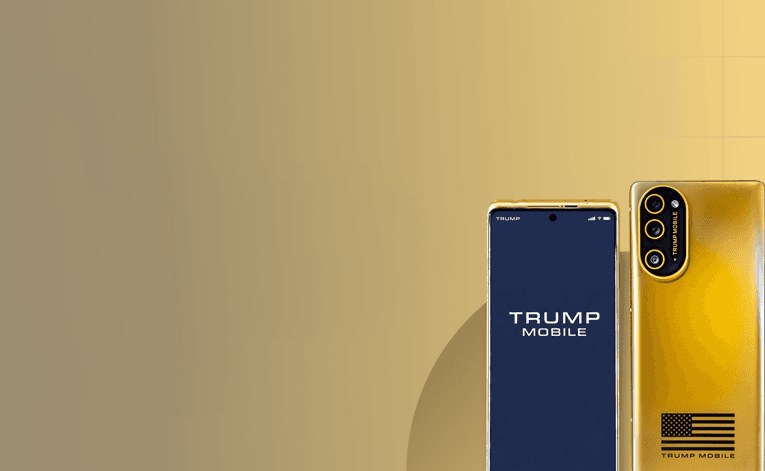
The gold colour is not gold. There are at least three different shades of yellow on this phone and none of them match each other. The camera rings are one colour, the plastic surround is another, the back panel is a third, and the aluminium frame is orange. Trump has publicly said you cannot make a paint that looks like gold, and the T1 is proof of that statement.
The spying question comes up with anything connected to politics and I ran a packet capture to check. The network traffic is entirely normal. Google services, the Play Store, True Social when the app is open and nothing when it is closed. There is no mystery traffic, no unusual DNS requests, nothing that raises a flag. The phone is not spying on you. It is just not a good phone.
The software is close to stock Android with a custom splash screen and True Social pre-installed. The bootloader is unlockable, which is something most modern Android phones do not allow and which is actually a genuinely appealing feature for anyone who wants to install a custom ROM. The olephobic coating on the screen is poor and fingerprints collect on the display constantly.
At $500 the Samsung Galaxy S25 FE outperforms this phone in every measurable category. Better cameras, better software, a working fingerprint sensor, future software updates, thinner chassis. The T1 is not a $130 rebranded phone as early rumours suggested. It is more than that. But more than a $130 phone is not the same as worth $500, and the broken fingerprint sensor, the mismatched gold paint, and the printer paper quick start guide make it very difficult to recommend to anyone who is actually looking for a smartphone rather than a piece of political memorabilia.