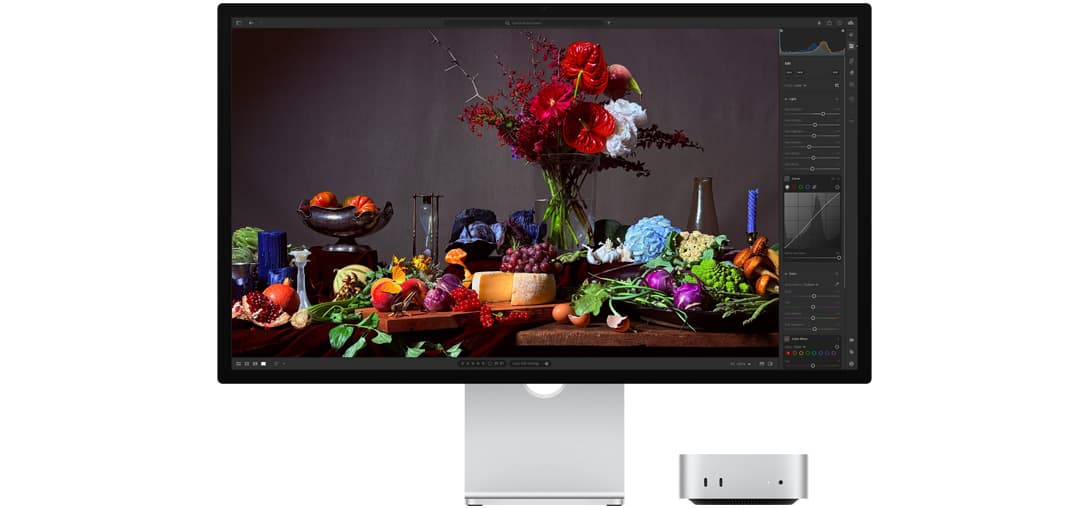
I have been calling this a monitor all week and I think that framing is the reason so many people look at the price and immediately decide it makes no sense. A monitor is a screen you plug into a computer. The Apple Studio Display is something different and thinking about it correctly changes the entire value calculation.
Inside this display is an A19 processor, the same chip Apple put in the latest iPhone. It is there to run the 12MP Center Stage camera with Desk View, the three-mic array, and the six-speaker system with Spatial Audio. What you are actually buying is half of an iMac. The other half is the Mac Mini or MacBook you already own or plan to buy. Once that clicks, the price starts making a different kind of sense.
The build quality lands this impression the moment you take it out of the box. Brushed aluminium that Apple has been refining for years, clean and minimal along the back with just four USB-C ports where most monitors cram in HDMI, DisplayPort, DVI, and a collection of USB-A ports nobody asked for. Two of those USB-C ports are Thunderbolt 5. One connects directly to your Mac. The second lets you daisy chain to another display. If you are running a MacBook, the display charges it through the same cable carrying video. One cable in, everything works.
The panel is a 27 inch 5K Retina display at 14.7 million pixels with 600 nits of brightness, P3 wide colour, and support for one billion colours. It is an LED panel, not OLED or Mini LED like the Pro Display XDR, and I want to be honest about what that means in practice. Sitting next to the XDR for a week I could find differences when I went looking for them. Deeper blacks on the XDR, stronger HDR contrast, higher peak brightness. But when the two are not side by side those differences are less dramatic than the spec gap between them suggests. For content that is not pushing HDR, which is most creative work outside broadcast video and high-end photography, the Studio Display holds up impressively well. Apple has always built displays that look better than their specifications suggest and this continues that tradition.
The 60Hz refresh rate is the specification that draws the most criticism and I understand why. At $1,600 it is genuinely difficult to find a monitor above $500 that does not offer at least 120Hz. Apple is clearly reserving higher refresh rates for the XDR to protect that product's position. Whether 60Hz matters in practice depends on what you are doing. Mac gaming exists but most titles that run on Apple silicon are not hitting framerates where 60Hz becomes a bottleneck. For design, illustration, video editing, and general productivity work, 60Hz is not something I noticed as a problem during daily use. On a phone or tablet the difference between 60Hz and 120Hz is immediately visible because of how much animation and scrolling happens. On a desktop computer doing creative work it is less apparent.
The camera and audio are where the A19 chip justifies its presence. The 12MP Center Stage camera tracks you as you move during video calls without any manual adjustment. Desk View is a mode that uses the wide-angle lens to show a top-down view of your desk surface simultaneously with your face, which is useful for anyone explaining physical work or handwriting during calls. The three-mic array handles noise cancellation cleanly. The six-speaker system with Spatial Audio produces sound quality that I would not have believed came from a monitor if I were not sitting in front of it. These are not monitor speakers. They are genuinely good.
The colour consistency between the Studio Display and Apple's current MacBook panels is one of the quieter advantages of staying within the ecosystem. Moving an image from a MacBook screen to this display and back shows no visible colour shift. Anyone who has plugged a third-party monitor into a laptop and watched colours change as a window crosses from one screen to the other knows exactly how valuable that consistency is.
The standard stand is fixed at one angle and cannot be height adjusted. Adding height adjustment costs an additional $400, which is difficult to defend as a separate purchase on a monitor at this price. A VESA mount option exists but must be selected at checkout since the stand is integrated into the back panel rather than removable after purchase.
Specifications
| Feature | Details |
|---|---|
| Screen Size | 27 inches (68.29 cm) |
| Resolution | 5K Retina (5120 × 2880) |
| Total Pixels | 14.7 million |
| Brightness | 600 nits |
| Colour Support | 1 billion colours |
| Colour Gamut | P3 wide colour |
| Refresh Rate | 60Hz |
| Processor | Apple A19 |
| Camera | 12MP Center Stage with Desk View |
| Microphone | Three-mic array |
| Speakers | Six-speaker system with Spatial Audio |
| Ports | Thunderbolt 5 × 2, USB-C × 2 |
| MacBook Charging | Yes, via Thunderbolt connection |
| Daisy Chaining | Yes, via second Thunderbolt 5 port |
| Stand | Fixed angle, height adjustment +$400 |
| VESA Mount | Available at checkout |