A few months ago, I finished a small indie game about a fox searching for her lost cubs. The visuals were simple watercolor sketches, the music was a single acoustic guitar, and the entire experience lasted maybe three hours. By the end, I was sitting in front of my monitor with tears rolling down my face. A week earlier, I had uninstalled a $70 AAA blockbuster after six hours because I felt absolutely nothing. That contrast got me thinking about why indie games so often hit us in ways that massive productions struggle to match.
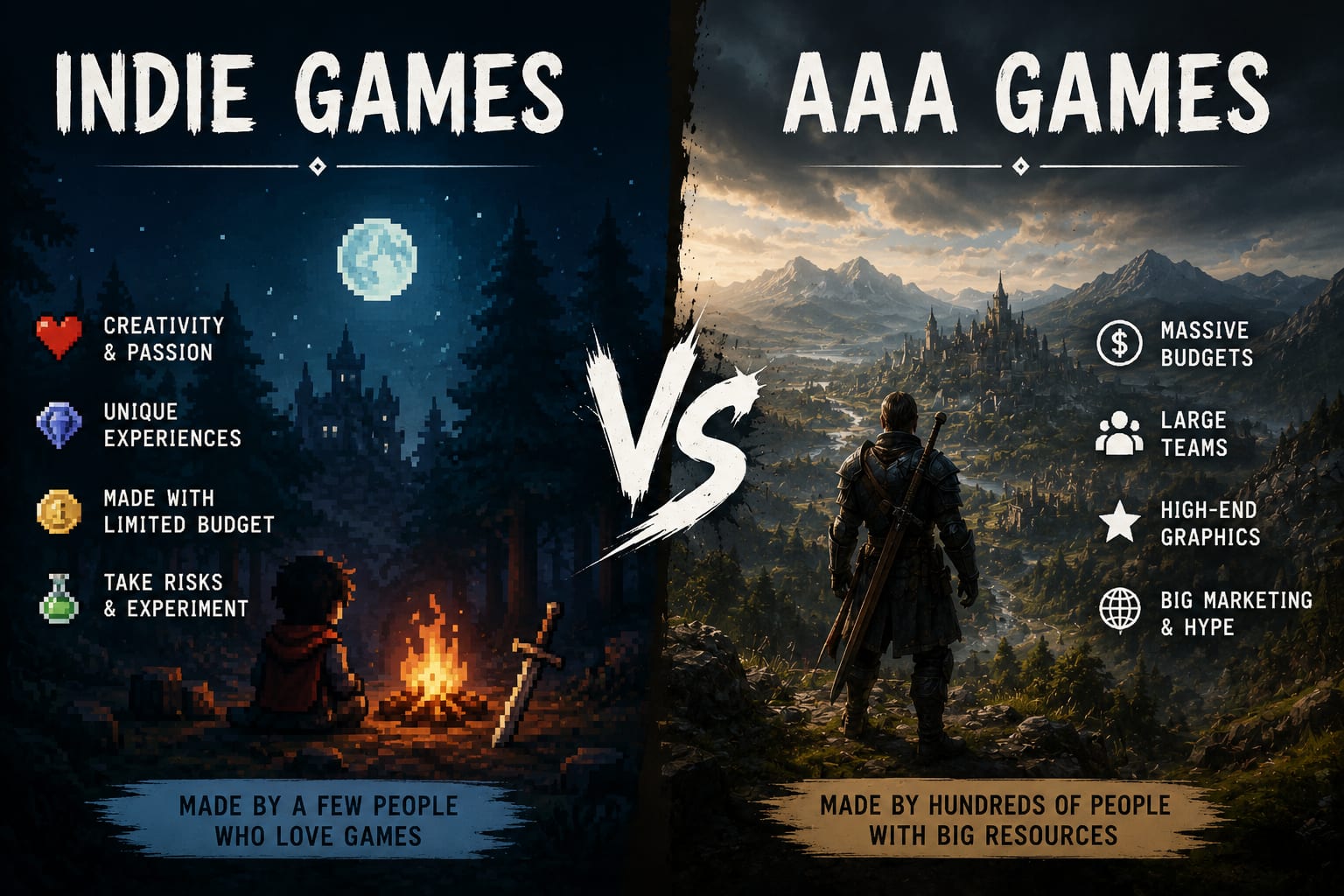
The most obvious difference comes down to creative freedom. When a small team of three people makes a game in their spare time, there are no shareholders demanding a return on investment, no marketing department insisting that every game needs a battle pass, and no corporate mandate to chase whatever trend is currently printing money. An indie developer can wake up one morning and decide to make a game about gardening in a post-apocalyptic world, or a visual novel exploring grief through the lens of a time loop, or a puzzle platformer where the main character is literally a piece of bread. These ideas would never survive a single committee meeting at a major publisher, not because they are bad ideas, but because they are too personal, too niche, or too risky to justify a hundred-million-dollar budget.
Risk is actually the word that defines the split between these two worlds. A AAA studio cannot afford to fail in any significant way. A single commercial flop can mean hundreds of layoffs, a plummeting stock price, and a canceled sequel that fans were already excited about. So the rational choice, from a business perspective, is to play it safe. Iterate on proven formulas. Sand down every rough edge until the product appeals to the widest possible audience. The result is often a technically impressive, highly polished experience that somehow feels empty, like a beautifully furnished house that nobody actually lives in. Indie developers, on the other hand, operate in a space where failure is survivable. They can afford to take wild creative swings because the financial stakes are lower, which paradoxically leads to games that feel far more alive and memorable.
There is also the matter of personal voice. When you play an indie game, you are often experiencing one person's singular vision or the intimate collaboration of a tiny, tight-knit team. You can feel the creator's fingerprints on every pixel, every line of dialogue, every strange design choice. The game becomes a conversation between you and another human being. A game like Celeste is openly about its creator's struggles with anxiety and self-doubt, and that vulnerability resonates precisely because it is not filtered through layers of focus testing. AAA games, by necessity, are made by hundreds or even thousands of people spread across multiple continents. Any individual's emotional truth gets diluted in that vast creative pipeline until what remains is a competent product designed by committee, unlikely to offend anyone but also unlikely to truly move anyone.
Then there is the relationship with the player community. Indie developers tend to hang out in the same Discord servers, respond to Steam reviews personally, and patch their games based on direct conversations with the people playing them. This loop creates a sense of shared ownership and genuine care that you can feel while playing. When an indie dev fixes a bug within hours of launch or adds a feature because a player sent a heartfelt email, that passion becomes part of the game's story. In the AAA space, community feedback is often filtered through layers of community managers, analytics reports, and quarterly planning meetings. It becomes data to be processed, not a human connection to be nurtured.
None of this means AAA games are inherently soulless or that indie games are automatically masterpieces. I have played stunningly beautiful, emotionally rich games from major studios, and I have played plenty of forgettable indie titles that felt like hollow imitations of better ideas. But when you compare the median experience, indie games simply have more room for the human heart to show. They are allowed to be messy, peculiar, and stubbornly personal in ways that a hundred-million-dollar product rarely can be. And in a medium where we spend so much time staring at screens, that little bit of human imperfection often matters more than any graphical horsepower ever could.