When I first saw the name Xuanjie O3 floating around in leaks, my immediate reaction was confusion. Xiaomi's previous chip was the O1. Lu Weibing had publicly said the next one would be called O2 and would arrive in August. So where did O3 come from and what happened to O2? The most plausible explanation doing the rounds is that O2 was already registered as a brand name by a European carrier, creating a trademark conflict Xiaomi decided to sidestep entirely by jumping to O3. Whether that turns out to be the full story, the name change alone generated more discussion about this chip before its release than most announced products manage after theirs.
The naming debate aside, what actually matters is what is inside, and the specifications leaked for the Xuanjie O3 represent a significant step beyond what the O1 delivered.
The CPU architecture has been restructured from a quad-cluster design to a three-cluster layout built around a super-large core, a titanium core, and an enhanced small core. The super core runs at 4.05GHz, which breaks the 4GHz barrier for mobile chips and sits above the O1's 3.89GHz. The titanium core handles medium to high load tasks at 3.42GHz. The change that genuinely caught my attention is the small core. It has gone from 1.79GHz in the O1 to 3.02GHz in the O3. That is not a small core in any traditional sense anymore. A 3GHz small core can handle foreground tasks that would previously have required waking a larger core, which means the chip can stay in a lower power state for more of the day without the user feeling it.
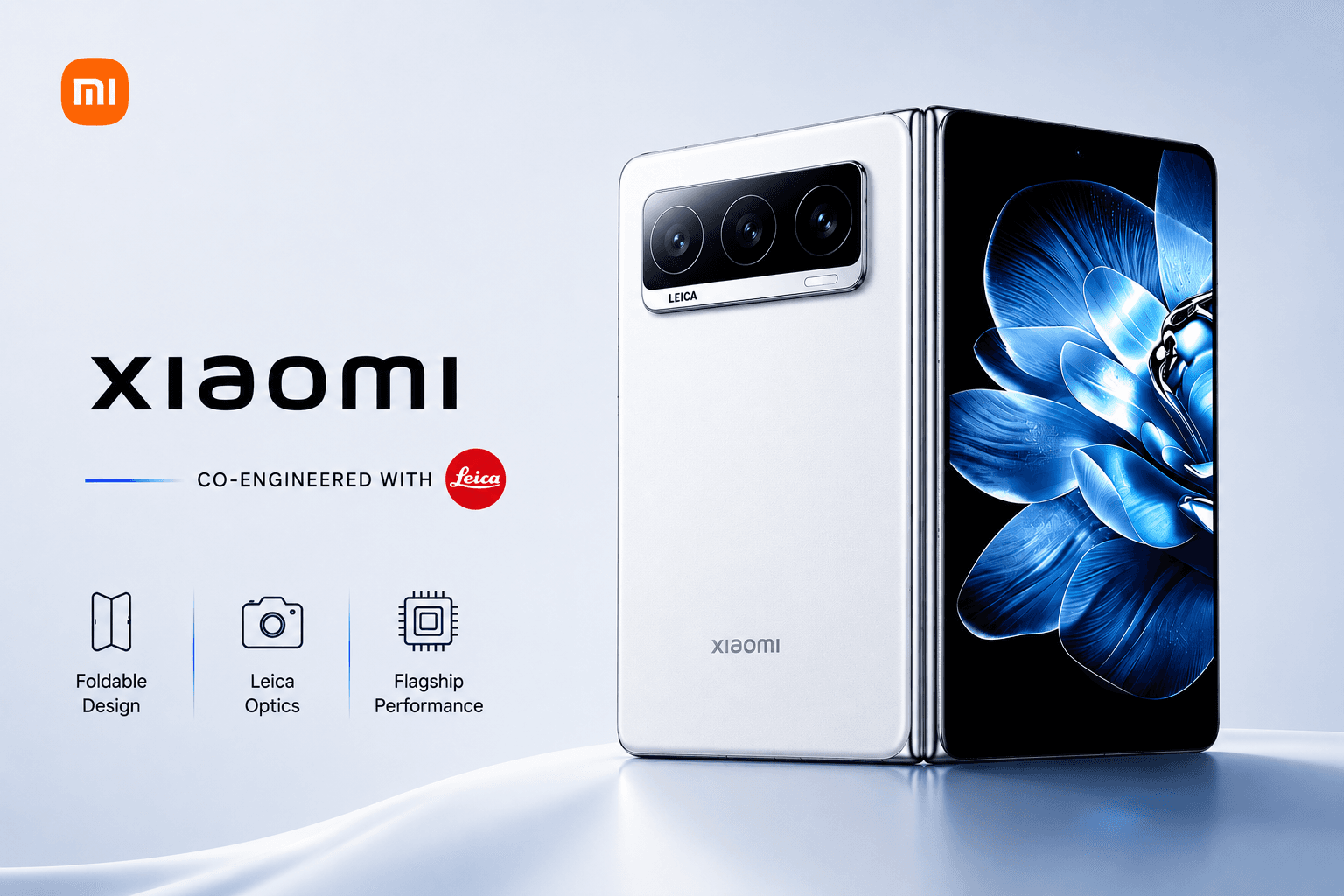
This matters more on a foldable phone than on a standard device. When the MIX Fold 5 is unfolded, split-screen use, floating windows, and large-screen multitasking become constant rather than occasional. Traditional chips handle that by pulling high-performance cores into scenarios that do not need them, which generates heat and drains battery. The O3's upgraded small cores are designed to absorb more of that background load without escalating up the power curve unnecessarily.
The GPU frequency has increased from 1.2GHz on the O1 to 1.49GHz on the O3, a roughly 25 percent improvement, most likely running an ARM Mali G1-Ultra. Memory bandwidth sits at 9600MT/s. The manufacturing process is TSMC's N3P, the third generation 3nm node. Xiaomi is not on 2nm, which Apple and Qualcomm have prioritised for themselves given limited initial capacity. N3P is the more realistic choice right now in terms of yield, cost, and mass production scale, and it is a proven process rather than an unproven one.
The projected benchmark numbers are the most ambitious I have seen from a Xiaomi chip. Based on the architecture improvements, single-core Geekbench 6 could exceed 3800 points, multi-core could clear 11000, and AnTuTu is expected to cross 4.2 million. If those numbers are confirmed, the Xuanjie O3 enters direct comparison with the Dimensity 9500, the Snapdragon 8 Elite Gen 5, and the Apple A19 Pro. That would be the first time a Xiaomi-developed chip has genuinely stood at the top of the performance chart rather than being a credible but second-tier option.
I want to be careful about getting too excited about those projections though. Benchmark numbers tell you what a chip can do in a controlled burst. They do not tell you what happens after 30 minutes of gaming when thermal limits start pressing, or how the chip behaves when navigation, messaging, music, and camera processing are all running together. The O1 proved Xiaomi could build a high-specification chip. The O3 has to prove Xiaomi can make one that holds up in real daily use without throttling, heating, or developing the inconsistencies that appear after months of use rather than the first week.
The MIX Fold 5 is an interesting choice for the debut. Foldable phones are the most demanding environment you can put a chip into. Slim chassis, constrained heat dissipation area, a hinge mechanism eating into internal space, and a user base that expects smooth multitasking across a large unfolded display. If the Xuanjie O3 runs cleanly on the MIX Fold 5, it demonstrates capability that a standard slab phone launch simply cannot. The MIX Fold 5 is expected in Q3 2026 at around 10,200 yuan (roughly $1,400 or ₹1,18,000 at exchange rate, expect higher in India after taxes and import duties).
The wider picture behind the O3 is Xiaomi's ecosystem ambition. The company wants its own chip running across phones, tablets, cars, and wearables so that the software layer connecting all of them can be optimised end to end without depending on Qualcomm or MediaTek's schedules. The O1 crossed one million units shipped, which means this is no longer an experiment. The O3 is the point where Xiaomi either proves the strategy scales into genuine flagship competition or reveals where the ceiling is.
I am genuinely curious to see the thermal data from real-world testing. A 4.05GHz super core and a 3.02GHz small core in a foldable phone chassis is an aggressive combination. The specifications are compelling. September will tell us whether the engineering behind them is too.