Everyone assumed Nvidia won the AI era. Jensen Huang is on magazine covers, CUDA is the default language of machine learning, and GPU supply chains bend around Nvidia's production schedule. That narrative is mostly true. But there is a quieter story running alongside it, one where AMD is making serious money and building real momentum without anyone paying much attention.
Start with CPUs, because that is where AMD's current strength actually comes from. Before 2019, Intel owned roughly 97 percent of the data center CPU market. That number sat at around 70 percent by 2025, meaning AMD carved out nearly a third of one of the most valuable markets in enterprise technology in about six years. The engine behind that shift is the EPYC processor lineup, which AMD has pushed from 32 cores at launch to 256 cores and 512 threads in its current generation. Intel, a company that spent decades treating high core counts as unnecessary, was forced to respond with its own stacked architectures. That reaction alone tells you how seriously the data center world took AMD's challenge.
The other weapon is 3D V-Cache, which sounds like a gaming gimmick until you see what it does in server environments. The EPYC 9684X packs 1152MB of L3 cache across 96 cores, nearly three times what competing Intel server chips offer. For workloads demanding ultra-low latency, financial transaction processing, complex simulations, and AI agent orchestration, that cache advantage translates directly into real performance gains. Data centers noticed. The contracts followed.
AI agents in particular are driving fresh CPU demand that benefits AMD directly. Running an AI agent means constant tool invocation, task scheduling, and context management, all of which lean on CPU throughput rather than raw GPU compute. Even Nvidia's Jensen Huang acknowledged this at a recent GPU technology conference by unveiling a CPU of their own. AMD has been selling exactly this kind of hardware to data centers for years already.
On the GPU side the story is more complicated, but the direction has shifted. For a long time AMD's graphics cards competed on price rather than performance, and for good reason. Nvidia's 2018 decision to add dedicated ray tracing and tensor cores gave it a structural lead that AMD spent seven years trying to close. The gap in software was just as wide. Nvidia's CUDA ecosystem had a decade of optimization work baked in. AMD's ROCm arrived late and supported fewer algorithms cleanly.
The 9000 series changed the trajectory. Ray tracing performance is finally competitive. FSR4, AMD's AI-based super resolution technology, can now go head to head with DLSS in visual quality where earlier versions could not. For PC gamers who kept choosing Nvidia cards partly for software reasons, AMD is now a legitimate option rather than just the budget pick. The pricing has always been AMD's strongest card in the consumer market, and now the technology has caught up enough that the value argument is genuinely compelling rather than just a compromise.
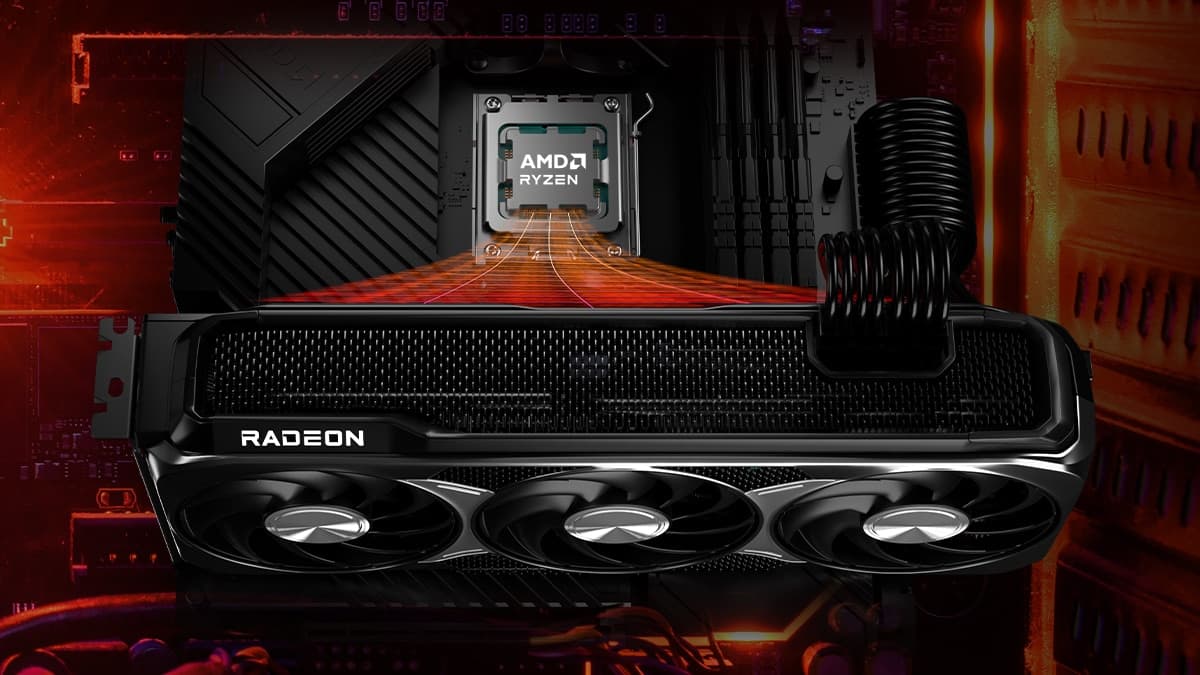
What makes AMD's position interesting right now is the combination of both sides. When AI agents and local model inference started demanding a tight integration of CPU and GPU power, AMD happened to have both. The AI Max+ 395 chip is the clearest expression of this. It puts a 16-core CPU and a 40-unit GPU onto a single die with shared memory, allowing users to run large language models locally without needing a separate discrete GPU. A Mac Studio configured for similar workloads can cost the equivalent of several lakhs. A desktop built around the 395 comes in significantly cheaper while handling mainstream LLM tasks without sending your data to a cloud server. For developers and researchers who care about privacy and local inference, that is a real alternative.
The ecosystem around ROCm is still AMD's weakest point. Mainstream LLM inference works well, but image generation, video models, and fine-tuning workflows are inconsistent in ways that CUDA users simply do not experience. AMD open-sourced ROCm to accelerate community contributions, and the recent AMD AI Developer Conference showed a clear strategy around building a full software pipeline from consumer devices through workstations to data center GPUs. Whether that pipeline matures fast enough to matter is still an open question.
But AMD is not the company it was five years ago. It is profitable, it is growing in the markets that matter most, its gaming GPUs are finally competitive on quality rather than just price, and it has a coherent answer to the AI infrastructure question. The assumption that Nvidia walks away with the entire AI era unchallenged is looking less solid every quarter.